

73% of readers can identify AI-generated content within seconds. Not because AI lacks facts — it’s often accurate. But because AI writes the way a machine thinks humans write, not the way humans actually do.
You’ve probably felt it yourself. You generate a paragraph, read it back, and something feels off. The words are technically correct. The sentences are grammatically fine. But the whole thing reads like a brochure from 1998.
Here’s the good news: learning how to make AI writing sound human isn’t about hiding that you used AI. It’s about producing writing that genuinely connects with readers. This guide gives you a two-phase system — fix it at the prompt level first, then polish the output second. You’ll get practical examples, a framework you can use immediately, and an honest look at where even the best editing has limits.
Why AI Writing Sounds Robotic in the First Place
Before you fix the problem, you need to know what causes it.
AI language models predict the next most likely word based on patterns in training data. That process creates writing that is statistically average — which means it defaults to the most common sentence structures, the safest vocabulary, and the most predictable transitions.
Real human writing breaks patterns. It speeds up. It slows down &t uses a short sentence for emphasis. Then it backs up with a long one that adds nuance or shifts direction. AI rarely does this without being told.
The other major issue is specificity. Human writers draw on personal experience and concrete detail. AI defaults to generalisation because generalisations appear most frequently in training data. Phrases like “it’s important to,” “this can help you,” and “there are several ways” are AI’s comfort zone. They’re also the phrases that kill credibility fastest.
Phase 1 — Get Better Output From the Start

Most guides skip this phase entirely. They tell you to edit AI writing after it’s generated. But if you build the right instructions into your prompt, you reduce editing time by half.
Write prompts that specify tone and voice
Vague prompts produce vague writing. Instead of asking for “a blog post about productivity,” give the AI a persona and a specific constraint.
Try: “Write this in a direct, conversational tone. Use short sentences. Avoid phrases like ‘it’s worth noting’ or ‘in today’s world.’ Write as if you’re explaining this to a smart friend over coffee.”
That single instruction set changes the entire output. You’re not asking AI to be human — you’re restricting it from being robotic. If you want to go deeper on this, our guide to prompts that produce natural writing covers the full framework for structuring instructions that get better results every time.
Tell AI what to avoid
AI has habitual phrases. You can block them directly in your prompt. List the words and structures you don’t want: filler transitions, passive constructions, vague openers.
For example: “Do not start any sentence with ‘Additionally’ or ‘Furthermore.’ Do not use the word ‘robust.’ Avoid generic statements.”
This works because AI language models respond to negative constraints just as effectively as positive instructions — sometimes more so.
Ask for specificity by default
Add this line to almost any prompt: “Include at least two specific, concrete examples or data points.”
Specificity is the single biggest difference between AI writing that feels human and AI writing that doesn’t. Humans remember specific details. Machines summarise. When you force specificity at the prompt level, you get output that’s already closer to natural writing.
Give AI a sample of your own writing
If you have a style you want to match, paste a paragraph of your own writing into the prompt and say: “Match the voice and rhythm of this example.” This is one of the fastest ways to close the gap between generic AI output and content that sounds like a real person wrote it.
Phase 2 — Edit the Output Like a Human Writer

Even the best prompts produce output that needs editing. This phase is where you close the gap between “technically fine” and “genuinely good.”
Fix sentence rhythm first
Read the AI output out loud. Seriously — out loud, not in your head. Your ear catches what your eye misses.
AI writing tends toward a consistent rhythm: medium sentence, medium sentence, medium sentence. Human writing varies constantly. When you read AI content aloud, you’ll hear where it feels like a metronome. Break those patterns deliberately.
Chop a long sentence into two short ones. Combine two short ones into a longer one. Add a sentence fragment for emphasis. Good rhythm.
Replace weak transitions with cause-and-effect logic
AI loves transitions like “Additionally,” “Moreover,” and “In addition.” These words are essentially filler — they signal that the next sentence is coming without explaining why. Replace them with logic that shows how two ideas connect.
Instead of: “Additionally, AI writing lacks personality.”
Write: “That lack of pattern variation is exactly why AI writing feels flat.”
The second version explains the relationship. The first one just sequences sentences.
Inject specific details that only a human would know
This is where your personal knowledge matters most. Take any paragraph AI generates and ask: where can I add a real number, a named example, or a personal observation?
For example, if AI writes: “Many writers find AI tools useful for brainstorming,” you can edit it to: “Writers who use AI for brainstorming report saving an average of 30% on outlining time, according to a study from HubSpot on AI in content marketing.”
Specificity builds trust. Generality destroys it.
Cut filler phrases without mercy
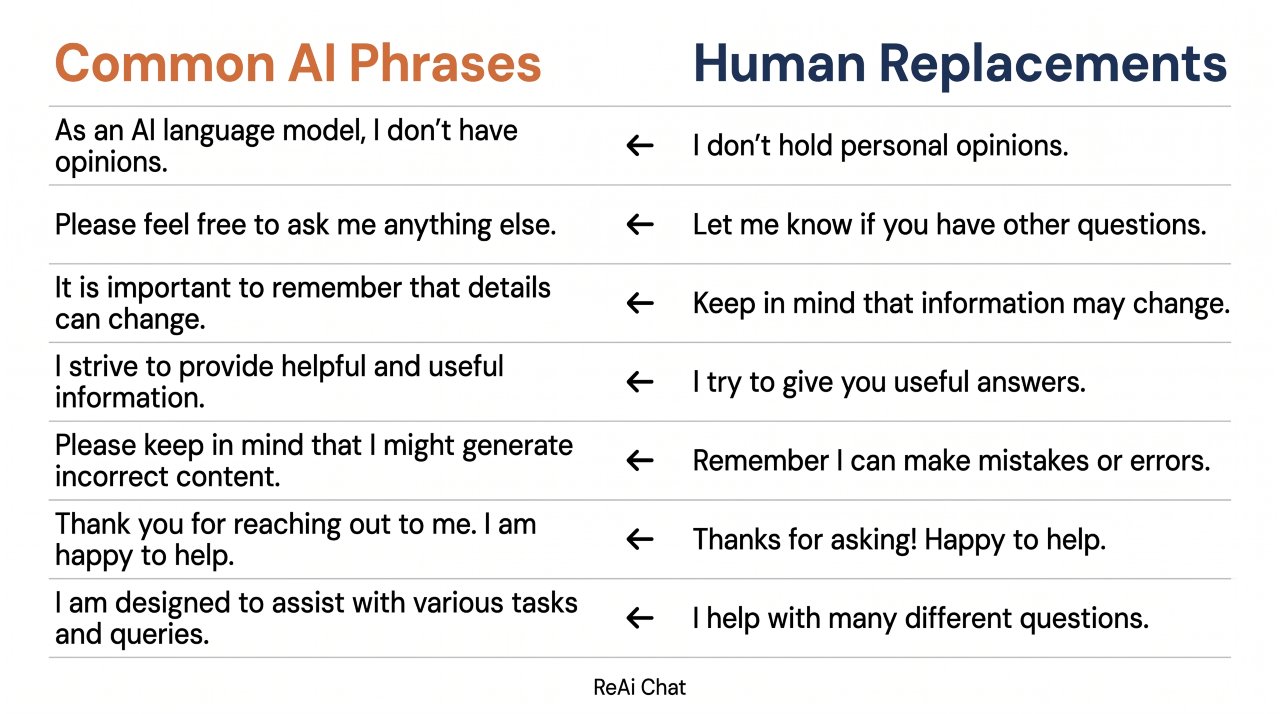
AI writing is full of throat-clearing. These phrases add words but remove force:
| Weak AI Phrase | Replace With |
|---|---|
| “It’s important to note that” | Just say the thing |
| “There are several ways to” | Name one and start |
| “This can help you to” | “This does X” |
| “In order to achieve” | “To get” |
| “It goes without saying” | Delete entirely |
| “As previously mentioned” | Delete entirely |
| “Many people find that” | Name a specific group or example |
Cutting these phrases tightens your writing instantly. A 500-word AI paragraph often becomes a sharper 380-word one after this pass.
Add vulnerability and opinion
Human writing takes positions. It admits when something is hard. It acknowledges uncertainty. AI writing is optimistic by default and tends to avoid strong stances.
When you edit AI content, look for places to add your actual opinion. “Honestly, this approach takes more time than most tutorials admit.” Or: “The results aren’t always consistent — you’ll need to experiment.” These moments of honesty build the reader’s trust faster than any perfectly phrased paragraph can.
The Biggest Mistakes Writers Make With AI Content
Even experienced writers fall into these patterns. Knowing them helps you avoid them.
Mistake 1: Treating AI output as a first draft you just lightly edit. AI output is a raw material, not a draft. The best writers use it as a skeleton and rebuild around it.
Mistake 2: Forgetting that rhythm is a skill. You can’t fix rhythm by changing individual words. You fix it by restructuring sentences at the paragraph level. This takes practice, but it’s learnable.
Mistake 3: Skipping the read-aloud step. This single step catches more problems than any tool. If you can’t read a paragraph naturally at normal speaking speed, it needs rewriting.
Mistake 4: Over-relying on AI detection as a quality signal. AI detectors have high error rates. Research from the University of Maryland found detection tools misclassify human writing as AI up to 20% of the time. Use human judgment, not a detector score, to evaluate your content.
How to Build This Into Your Daily Writing Workflow
You don’t need to do all of this every time. Start with the parts that give you the highest return.
If you write regularly with AI, build a personal prompt template. Include your tone instructions, your forbidden phrases, and a sample of your own writing. Save it. Paste it at the start of every session. Understanding why human-sounding content matters goes beyond reader experience — it directly affects how your content performs in search.
For editing, do three passes: one for rhythm (read aloud), one for specificity (add real details), one for filler (cut weak phrases). Three passes sounds like a lot. In practice, each one takes under five minutes for a 500-word piece.
Over time, you’ll build an instinct for spotting AI patterns before they reach your final draft. That instinct is worth more than any single technique in this guide.
Honest Limitations: What This Can’t Fix
There’s a real ceiling here, and you should know about it.
If you generate five hundred words of AI content and make minimal changes, the result will still feel thin to a careful reader. No editing technique fully compensates for the absence of genuine human experience behind the words.
AI also doesn’t know what you know. It doesn’t know your industry’s inside jokes, the frustrations your specific customers feel, or the counterintuitive lesson you learned last quarter. Only you can add those things. That’s why the editing phase isn’t optional — it’s where your value as a writer lives.
The goal isn’t to trick readers into thinking a machine is a human. The goal is to use AI as a drafting tool while keeping your judgment, voice, and knowledge as the primary ingredient.
FAQ
How do I make AI writing sound more natural?
Focus on two things: sentence rhythm and specificity. Read your AI output aloud to catch robotic patterns, then add concrete details, examples, or data that AI couldn’t have produced on its own. These two steps do more than any single tip.
Can AI writing be detected by readers?
Yes — most readers intuitively sense AI writing even if they can’t name why. The tells are consistent rhythm, vague generalizations, and absence of genuine opinion or personal experience. Fixing those three elements goes a long way toward closing the gap.
What makes AI writing so obvious?
AI writing defaults to safe, statistically average sentence patterns. It avoids strong opinions, uses predictable transitions, and generalises instead of specifying. These patterns appear because the model is trained to produce the most likely next word, not the most human one.
Is there a tool to make AI writing sound human?
Several tools claim to rewrite AI content to sound more natural. They have mixed results. Most experienced writers find that manual editing using the techniques above produces better results than any automated rewriting tool.
How do you add personality to AI-generated content?
Inject your actual opinions, name specific examples, and acknowledge difficulty or uncertainty. Personality in writing comes from taking positions and being specific. AI defaults to neutral and general — your edits should move in the opposite direction.
Does rewriting AI content make it undetectable?
Thorough rewriting that adds specificity, changes rhythm, and incorporates personal knowledge does reduce detection signals significantly. But the better goal is producing writing that genuinely serves your reader — that’s the standard worth optimising for, not detector scores.
You Now Have a Real System
The single most important idea in this guide: stop treating AI output as something to polish and start treating it as something to rebuild. Your prompts set the ceiling, and your editing fills the gap between ceiling and floor.
Your next step is concrete. Open your most recent AI-generated piece and read it aloud right now. Count how many sentences start the same way, or follow the same rhythm. That count tells you exactly how much work the piece needs — and where to start.
AI is a powerful writing tool. You’re the writer. Keep it that way.